Sudden Big Toe Pain, Redness, or Swelling? Could It Be Gout?
Imagine waking up in the middle of the night with sudden, intense pain in your big toe. The joint feels swollen, warm, tender, and even the light pressure of a bedsheet feels uncomfortable.
While several conditions can cause joint pain, these symptoms are commonly associated with gout, a type of inflammatory arthritis that often affects the big toe.

What Is Gout?
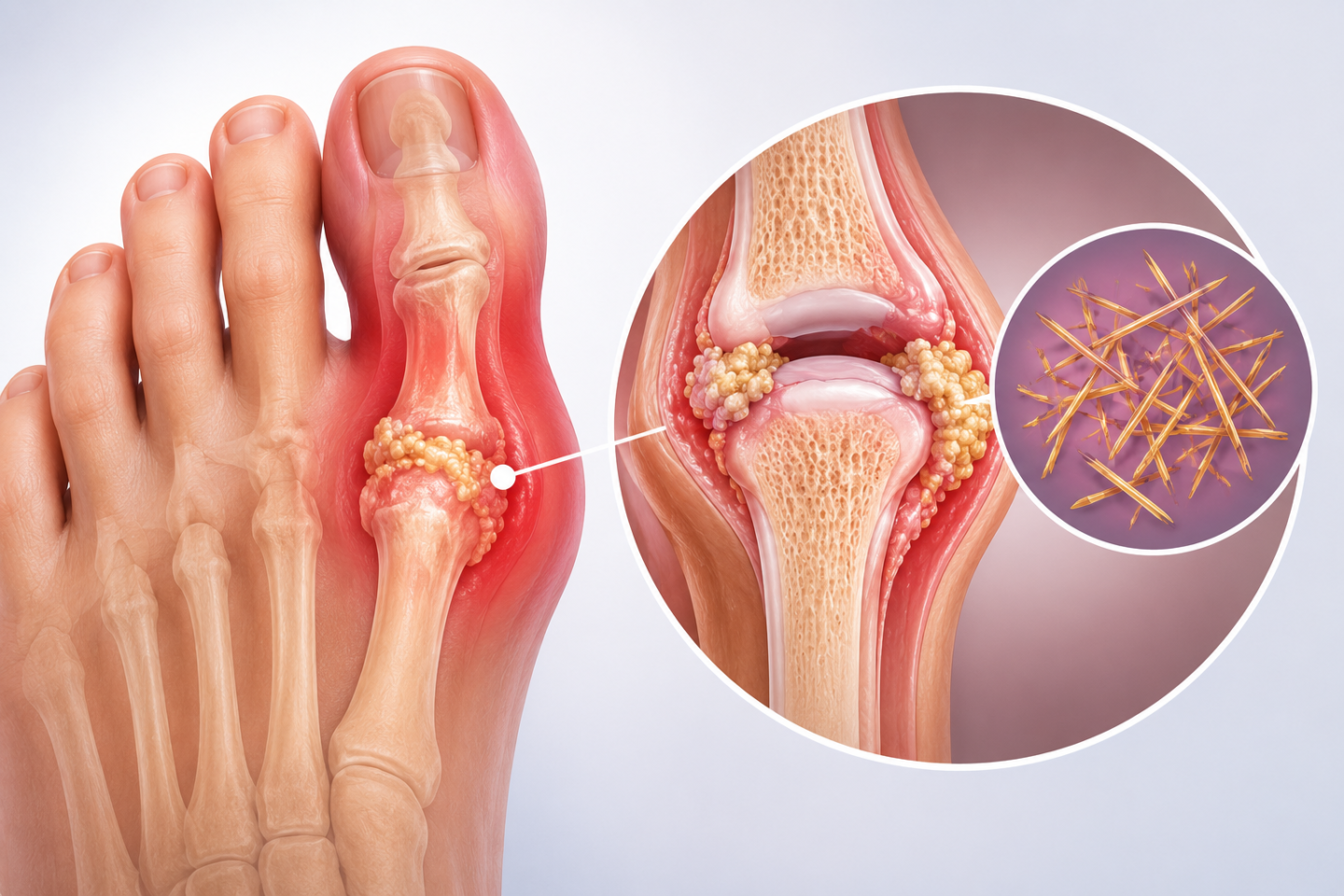
Gout is a form of inflammatory arthritis that causes episodes of joint pain and swelling, often called gout flares or attacks.
Gout develops when high levels of urate build up in the body over time. This can lead to the formation of needle-shaped crystals in and around a joint, triggering inflammation, swelling, and pain.
Although the big toe is one of the most common places for a gout flare to begin, gout can affect other joints as well.
What Does a Gout Attack Feel Like?
Gout attacks often begin suddenly and may occur at night.
Common symptoms can include:
- Sudden, intense joint pain
- Swelling around the affected joint
- Redness
- Warmth
- Tenderness or sensitivity to touch
- Difficulty moving the affected joint
The big toe is commonly affected, but gout can also occur in the ankles, knees, elbows, wrists, and fingers.
Symptoms may improve after a flare, and some people can go long periods without experiencing another one. Others may experience recurring attacks.
Why Does Gout Happen?
Gout is associated with a buildup of urate, which is produced when the body breaks down substances called purines.
Normally, urate travels through the bloodstream to the kidneys and is removed from the body through urine.
However, when the body produces too much urate or the kidneys remove too little, levels can build up. Over time, urate crystals may form in and around the joints and cause inflammation.
Importantly, having a high uric acid or urate level does not automatically mean that you have gout. Many people can have elevated levels without developing the condition.
Is Gout Only Caused by What You Eat?
No.
Diet can influence uric acid levels and may contribute to gout risk, but gout is more complicated than simply eating the “wrong” foods.
Several factors may increase a person’s likelihood of developing gout, including:
- Family history of gout
- Certain medical conditions
- Kidney disease
- High blood pressure
- Obesity
- Certain medications
- Alcohol consumption
- Diets high in certain purine-rich foods or fructose-sweetened beverages
This is why gout shouldn’t simply be viewed as a condition caused by someone’s diet.
Can Gout Cause Lumps Around the Joints?
When gout remains untreated for a long period of time, some people can develop deposits of urate crystals known as tophi.
Tophi can appear as firm lumps under the skin around joints and other areas of the body.
They may initially be painless, but over time they can contribute to joint and soft-tissue damage.
When Should You Talk to a Healthcare Provider?
Sudden pain, redness, or swelling in your big toe does not automatically mean that you have gout.
Other medical conditions can cause similar symptoms, so proper evaluation is important.
If you experience sudden and intense joint pain, consider contacting a healthcare professional for evaluation.
If a joint is hot and inflamed and you also have a fever, seek prompt medical care, as these symptoms can also occur with an infection.
A healthcare professional may review your symptoms and medical history, examine the affected joint, and use laboratory tests, joint-fluid testing, or imaging when appropriate to help determine the cause.
Research Is Helping Us Learn More About Gout
Researchers continue to study gout to better understand the condition and evaluate potential approaches to its treatment and management.
Clinical research studies are an important part of that process.
At SCLA Management, we work with clinical research sites across the United States conducting studies across a variety of medical conditions, including gout.
Interested in Clinical Research?
If you have been diagnosed with gout, you may be eligible for a clinical research study.
Explore our current research opportunities to learn more about studies that may be available near you.
This article is for educational purposes only and is not intended to provide medical advice, diagnosis, or treatment. Always speak with a qualified healthcare professional about symptoms or medical concerns.
Sources
National Institute of Arthritis and Musculoskeletal and Skin Diseases (NIAMS)
Gout: Symptoms, Causes, & Risk Factors
https://www.niams.nih.gov/health-topics/gout
Mayo Clinic
Gout — Symptoms and Causes
https://www.mayoclinic.org/diseases-conditions/gout/symptoms-causes/syc-20372897
National Institute of Arthritis and Musculoskeletal and Skin Diseases (NIAMS)
Gout: Diagnosis, Treatment, and Steps to Take
https://www.niams.nih.gov/health-topics/gout/diagnosis-treatment-and-steps-to-take