Why Are Some Clinical Trials Designed With Multiple Treatment Groups?
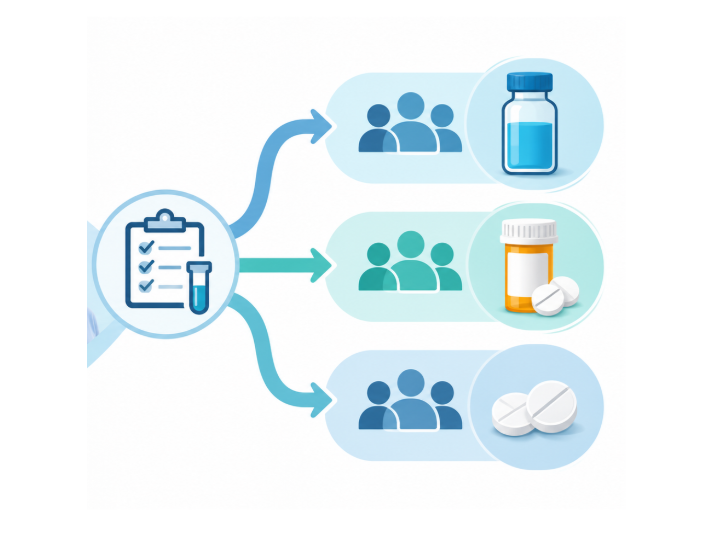
If you’ve ever read about a clinical trial, you may have noticed that participants are sometimes assigned to different groups.
One group might receive an investigational medication. Another might receive an existing treatment, a placebo, or a different dose.
But why are clinical trials designed this way?
Using different treatment groups helps researchers compare outcomes and better understand whether an investigational treatment works as intended.
Let’s explore how these groups work and why they are an important part of clinical research.

What Is a Treatment Group in a Clinical Trial?
A treatment group, sometimes called a study arm, is a group of participants assigned to receive a particular intervention or follow a specific study procedure.
Depending on the study, researchers may compare:
- An investigational treatment with an existing treatment
- An investigational treatment with a placebo
- Different doses of the same investigational medication
- An investigational treatment added to standard care versus standard care with a comparator
- Different treatment strategies or combinations
Not every clinical trial includes multiple groups.
Some studies evaluate only one intervention, while others use more complex designs to answer specific research questions.
Why Do Researchers Compare Different Groups?
Imagine researchers want to understand whether a new treatment improves symptoms associated with a medical condition.
If every participant receives the same treatment, it may be difficult to determine whether changes are related to the intervention or to other factors.
Comparing groups can help investigators evaluate differences in outcomes.
Researchers may examine whether participants receiving one intervention experience different benefits, side effects, or other measurable changes than participants in another group.
These comparisons help generate evidence about potential treatment effects.
What Is Randomization?
Randomization is a process used in many clinical trials to assign participants to treatment groups by chance.
Rather than allowing investigators or participants to choose the group, a random allocation process determines the assignment.
This helps reduce certain types of bias and can make comparisons between groups more reliable.
However, not every clinical trial is randomized.
The study design depends on the research question, medical condition, treatment being evaluated, and other scientific considerations.
What Is a Placebo?
A placebo is an inactive substance or procedure designed to resemble the intervention being studied without containing its active therapeutic component.
Placebos may be used in some clinical trials to help researchers distinguish treatment effects from other influences.
However, not all clinical trials use placebos, and placebo use must be evaluated carefully from scientific and ethical perspectives.
Some trials compare an investigational treatment with an established treatment rather than an inactive placebo.
In other studies, participants may continue receiving standard care while researchers evaluate an additional investigational intervention.
The informed consent process should explain whether a placebo may be used and what that means for participants.
What Does Blinding Mean?
Blinding is another research method used to reduce bias.
In a single-blind study, participants may not know which treatment they are receiving.
In a double-blind study, both participants and certain members of the research team may be unaware of treatment assignments.
The exact blinding arrangements vary by protocol.
Some studies are open-label, meaning treatment assignments are known.
Blinding helps limit the influence that expectations may have on how outcomes are reported or assessed.
Can Participants Choose Their Treatment Group?
In randomized trials, participants generally cannot choose their assigned group.
Before agreeing to participate, individuals should receive information about the study’s interventions, the assignment process, and the possible risks and benefits.
They should also have the opportunity to ask questions and consider whether participation is right for them.
Participation in clinical research is voluntary, and individuals can withdraw in accordance with applicable requirements without penalty or loss of benefits to which they are otherwise entitled.
Why Do Some Trials Include More Than Two Groups?
Some studies are designed to answer several related questions.
For example, researchers may want to compare two investigational doses with a control group.
Another study might evaluate whether adding a new intervention to an existing treatment produces different outcomes.
Including multiple groups can help researchers gather evidence about these questions within one research program.
However, more groups can also make a study more complex to design, coordinate, and analyze.
Understanding Research Builds Confidence
Clinical trial designs can appear complicated, but each element serves a scientific purpose.
Treatment groups, randomization, and blinding are among the methods researchers may use to evaluate investigational interventions more reliably.
For patients, understanding these concepts can support more informed conversations with healthcare professionals.
For investigators and research organizations, communicating study procedures clearly is an important part of ethical, participant-centered research.
At SCLA Management, we believe that helping people understand clinical research is an important part of supporting informed participation.
Explore Current Clinical Studies
Medical Disclaimer: This article is intended for general educational purposes. Clinical trial designs and participant protections vary by study. Always review the informed consent information and discuss questions with the research team before participating.
Sources: